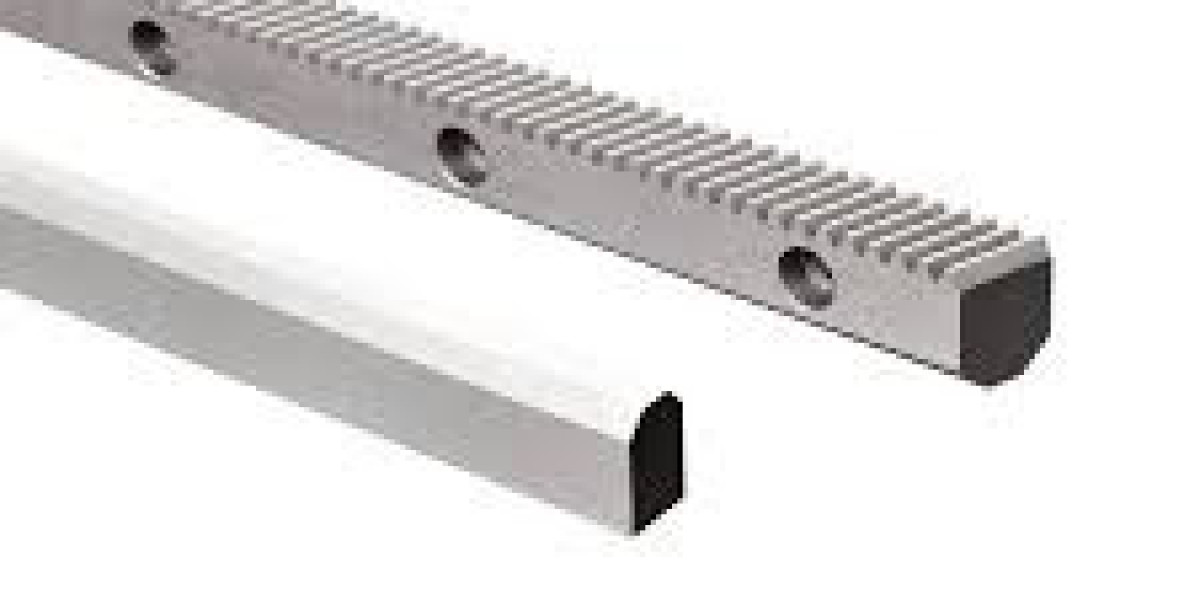

Industrial motion systems often need to combine smooth mechanical engagement with accurate positioning over a defined travel distance. A Helical Ground Rack brings together two important design and manufacturing considerations: angled tooth geometry for progressive engagement and precision grinding for improved tooth surface quality and dimensional consistency. This combination is relevant to equipment designers who need controlled linear movement and dependable transmission behavior under repeated operating conditions.
A rack-and-pinion transmission converts the rotation of a gear into straight-line displacement. In a helical arrangement, the teeth are inclined relative to the longitudinal direction of the rack. A compatible helical pinion engages with these teeth and transfers rotational input into linear movement. The gradual engagement associated with angled teeth can help reduce sudden contact changes and support smoother operation. The actual performance depends on the complete mechanical assembly and the compatibility of the mating components.
Grinding is generally applied as a finishing operation to refine the working tooth surfaces. Before grinding, the rack undergoes initial manufacturing operations to establish its basic dimensions and tooth geometry. Depending on the material and intended application, heat treatment may be performed to improve surface hardness and wear resistance. Grinding can then be used to improve dimensional consistency and refine the tooth profile after earlier processing stages. The selected manufacturing sequence depends on the required accuracy, rack dimensions, material characteristics, and production technology.
Tooth accuracy is particularly important for long linear transmission systems. A rack must maintain consistent pitch and suitable tooth geometry throughout its working length. Deviations may affect the contact relationship with the pinion, causing variations in engagement as the drive moves along the rack. These variations can contribute to vibration, noise, uneven loading, and positioning inconsistencies. Precision finishing helps address certain manufacturing deviations, although the final result also depends on installation and system design.
The material used for the rack should match the operating requirements. Steel is commonly selected for industrial transmission components because it provides a range of strength and processing options. Alloy steels may be considered where specific mechanical properties or heat-treatment characteristics are required. In applications involving repeated tooth contact, surface hardness and wear resistance are important factors. The material specification should therefore be evaluated together with the expected load, movement frequency, operating environment, and required service life.
The helical tooth arrangement introduces an additional design consideration: axial force. During engagement, the inclined teeth generate a force component along the pinion shaft. Bearings and supporting structures must be capable of handling this force under the intended operating conditions. Engineers should consider axial load capacity, shaft rigidity, bearing arrangement, and mounting accuracy when developing the transmission system. Ignoring these factors can lead to alignment changes and increased stress on supporting components.
A Helical Ground Rack can be considered for applications where controlled linear movement and refined tooth engagement are important. CNC machine tools may use rack-and-pinion drives for long-travel axes and machine positioning. Automated manufacturing lines can incorporate these components into transfer mechanisms, positioning platforms, and production equipment. Material handling systems may use them to move heavy assemblies along designated paths, while specialized industrial machinery may require similar transmission arrangements for repeated linear travel.
Choosing the appropriate rack begins with defining the machine's operating requirements. Important factors include travel length, load capacity, movement speed, acceleration, positioning accuracy, duty cycle, and expected operating life. Engineers should also determine the required module, pressure angle, helix angle, tooth width, and compatible pinion specifications. These dimensions must be evaluated as a matched system rather than selected independently. If the rack is intended to replace an existing component, the original drawings and mating gear information can help establish compatibility.
Installation precision is just as important as manufacturing precision. The mounting surface should be sufficiently rigid, flat, and properly prepared to support the rack under operating loads. Alignment should be checked across the complete travel distance, particularly when multiple rack sections are connected. Joint transitions require careful attention because changes in pitch continuity or mounting height can affect pinion engagement. Correct backlash adjustment also helps balance positioning requirements with the need for adequate operating clearance.
Lubrication and environmental protection influence long-term performance. The lubricant should be suitable for the material combination, operating speed, load, and temperature conditions. In environments containing metal chips, dust, moisture, or other contaminants, protective covers and regular cleaning may help prevent abrasive particles from entering the tooth engagement area. Inspection procedures should monitor unusual operating noise, vibration, visible tooth damage, and changes in positioning accuracy.
For industrial buyers, supplier evaluation should include manufacturing capability, inspection procedures, material documentation, and consistency between production batches. Technical drawings should specify the tooth geometry, working length, critical tolerances, material, hardness requirements, and mounting details. If grinding is a purchasing requirement, buyers should clarify which surfaces are ground and what inspection criteria apply to the finished component. This makes it easier to compare quotations based on equivalent technical specifications rather than price alone.
The final selection should account for both the rack and its associated drive components, including the pinion, shaft, bearings, and mounting structure. A coordinated specification helps reduce compatibility risks during assembly and commissioning. Buyers seeking additional information about precision rack products and related transmission configurations can visit https://www.yc-rack.com/product/spur-gear-rack/din6-highprecision-ground-hardened-spur-gear-rack.html.