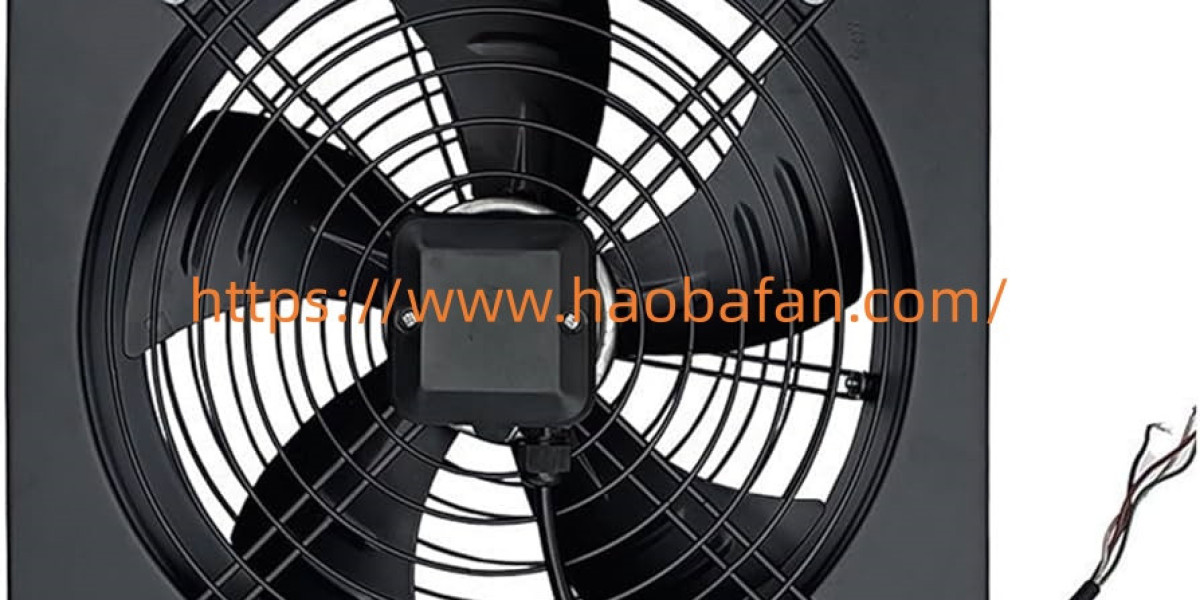

Equipment manufacturers increasingly require ventilation components that combine compact dimensions with dependable airflow performance. Refrigeration units, electronic cabinets, industrial machinery, and commercial HVAC equipment often have limited installation space, making fan configuration an important part of product engineering. An External Rotor Axial Fan combines an external rotor motor arrangement with an axial impeller, providing a practical solution for applications where air needs to move through equipment or ventilation openings along a relatively direct path.
The main operating principle is based on axial airflow. As the impeller rotates, its blades generate pressure differences that move air parallel to the motor shaft. Unlike centrifugal designs, which discharge air in a direction generally perpendicular to the inlet flow, axial fans maintain a more direct airflow path. This makes them suitable for ventilation arrangements that prioritize air volume, relatively straightforward installation, and limited equipment space.
The external rotor motor provides a distinctive structural arrangement. Its rotor is positioned outside the stator, and the impeller is commonly integrated with the rotating assembly. This configuration can reduce the need for a separate transmission system and help create a compact fan unit. Depending on the product design, the assembly may include a cylindrical housing, mounting flange, protective grille, electrical connections, and supporting components.
Blade design has a significant influence on operating characteristics. Blade diameter, number of blades, pitch angle, and aerodynamic profile determine how the impeller interacts with the surrounding air. Higher rotational speeds may increase airflow, but they can also influence power consumption, noise, and mechanical loading. Consequently, equipment designers should evaluate the complete fan performance rather than assuming that a larger motor or faster rotation automatically produces a better ventilation result.
One major application is industrial equipment cooling. Electrical control systems, electronic devices, welding equipment, and automated machinery can generate considerable heat during operation. Without sufficient ventilation, accumulated heat may affect component temperatures and equipment reliability. Axial fans can support heat removal by drawing cooler air into an enclosure or exhausting warmer air, depending on the installation arrangement.
Refrigeration and HVAC applications also require carefully selected airflow components. In heat exchange equipment, consistent air movement across the heat exchanger is important for maintaining the intended thermal operating conditions. The fan must be compatible with the available installation space, airflow resistance, temperature range, and electrical supply. A mismatch between the fan and the heat exchanger can result in insufficient airflow or unnecessary energy consumption.
Taizhou Haoba Electromechanical Co., Ltd. offers external rotor motor axial fan products, including the FZY series. Its published product information describes configurations using single-phase capacitor-operated asynchronous motors or three-phase asynchronous motors, together with cylindrical casings and protective grids. Listed applications include electronic equipment, computers, medical equipment, automated office equipment, welding machines, industrial plants, and warehouses. These application descriptions provide a useful starting point for buyers evaluating different ventilation requirements.
Electrical selection should begin with the equipment's actual power supply. Rated voltage, frequency, current, power, and motor phase must be compatible with the installation environment. Buyers should also confirm the wiring arrangement and capacitor requirements for applicable single-phase models. When a fan will be integrated into an OEM product, electrical connections and available installation space should be reviewed during the early design stage rather than after the equipment structure has been finalized.
Airflow and static pressure are two closely related performance considerations. The published maximum airflow of a fan does not necessarily represent the volume that will be delivered after installation. Protective grilles, filters, heat exchangers, duct connections, and restricted openings introduce resistance. Engineers should therefore identify the system's expected operating point and compare it with the fan's performance characteristics. This helps avoid selecting a unit that appears adequate in basic specifications but cannot meet the actual ventilation requirement.
Noise and vibration should also be considered, particularly for commercial equipment installed near operators or in occupied environments. Noise can result from aerodynamic turbulence, motor operation, mechanical imbalance, and vibration transmitted through the mounting structure. Appropriate installation, secure fastening, and regular cleaning can help maintain stable operation. Buyers should compare acoustic specifications under consistent measurement conditions and consider the complete equipment enclosure when evaluating sound performance.
For international distributors, OEM buyers, and equipment manufacturers, dimensional consistency and documentation are important purchasing factors. Installation drawings, model references, electrical specifications, and packaging details make it easier to integrate products into equipment designs and manage repeat orders. Suppliers should receive accurate information about the intended application, operating environment, quantity, and required electrical configuration before preparing a quotation.
Maintenance planning should include periodic inspection of the impeller, grille, electrical connections, mounting components, and ventilation passages. Dust accumulation may interfere with airflow and increase operating resistance. Abnormal vibration or unusual sound can indicate that further inspection is required. Maintenance procedures should follow the manufacturer's instructions and appropriate electrical safety practices.
When comparing different External Rotor Axial Fan models, purchasing teams should evaluate airflow requirements, pressure resistance, motor configuration, mounting dimensions, operating noise, and environmental conditions together. Taizhou Haoba Electromechanical Co., Ltd. supplies ventilation equipment for industrial and commercial applications, with several fan categories available for different air movement requirements. Buyers can explore its product range and discuss application requirements through https://www.haobafan.com/.