
Industrial machinery that requires controlled water delivery often benefits from pumping arrangements designed to reduce discharge fluctuations. A Three Plunger High Pressure Pump uses three separate pumping elements operating in a coordinated sequence to deliver liquid through a common hydraulic system. This configuration is particularly relevant to industrial cleaning, water jetting, and equipment maintenance applications. For machinery manufacturers and international distributors, understanding how the three-cylinder arrangement works is important when comparing pump configurations for different operating requirements.
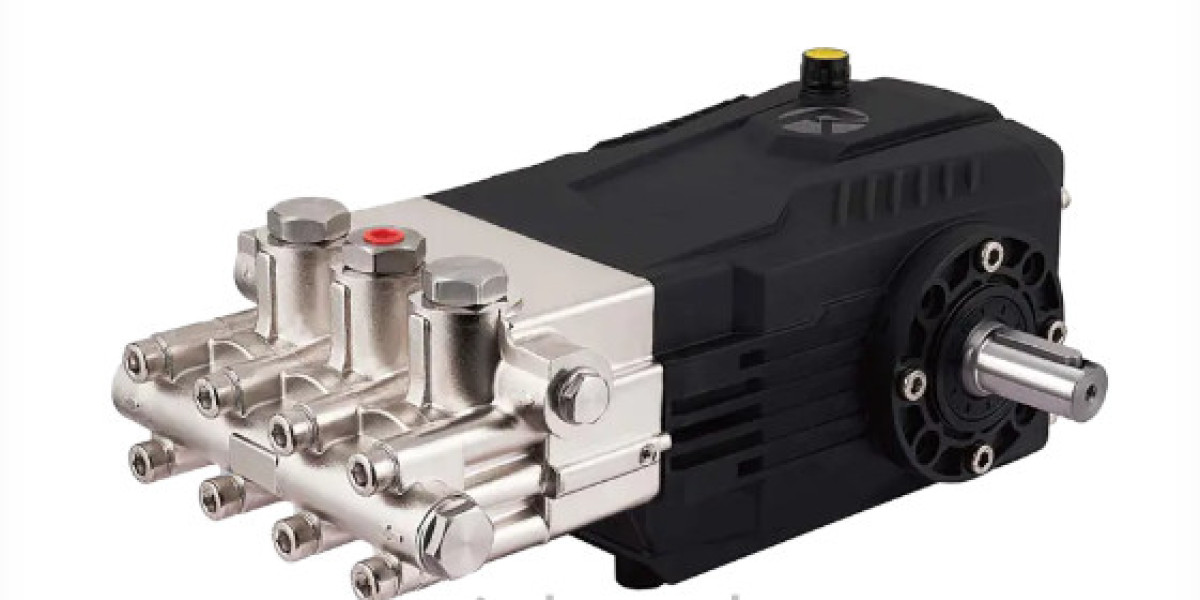
The main characteristic of this design is the use of three plungers connected to a common mechanical drive system. Each plunger moves inside its corresponding pumping chamber, creating alternating suction and discharge strokes. The crankshaft converts rotational movement into reciprocating motion through connecting rods or other mechanical transmission components. Because the three pumping elements operate at different positions in their cycles, their individual discharge events are distributed over the rotation of the drive shaft.
This arrangement helps produce a more consistent output than a comparable single-element configuration. Although the discharge flow is not perfectly uniform under every operating condition, the overlapping pumping cycles can reduce the amplitude of pressure and flow fluctuations. This is useful in systems where unstable delivery may affect the operation of spray accessories, cleaning nozzles, or other connected equipment. Actual pulsation characteristics depend on crankshaft geometry, operating speed, pump dimensions, and hydraulic system design.
Each pumping chamber contains an inlet valve and an outlet valve. During the suction stroke, the plunger moves away from the chamber head, creating a pressure difference that allows liquid to enter through the inlet valve. During the discharge stroke, the plunger moves forward and reduces the chamber volume. The resulting pressure closes the inlet valve and opens the outlet valve, allowing liquid to move into the discharge passage. The same process occurs in the other two chambers at different points in the mechanical cycle.
The pump head is an important part of the hydraulic assembly because it contains the pumping chambers and liquid passages. Its construction must accommodate the operating pressure and the characteristics of the transferred medium. Valve seats, sealing surfaces, and internal passages require appropriate machining and dimensional accuracy. Poor alignment or unsuitable clearances may contribute to leakage, inefficient operation, and premature component wear. The crankcase and transmission mechanism also require suitable lubrication to manage friction between moving components.
Material selection should reflect the application. Industrial water systems may require different wetted materials depending on water quality, dissolved minerals, additives, and temperature. Stainless steel can be considered for components requiring corrosion resistance, while other metals and engineered materials may be used for structural parts, valves, and seals. Buyers should verify the specifications of the actual wetted components and confirm compatibility with any cleaning agents or other liquids used in the installation.
Industrial pressure washing is one of the common applications of this configuration. In these systems, water passes from the pump through pressure-rated hoses and accessories before reaching the cleaning nozzle. The nozzle transforms the supplied hydraulic energy into a directed spray or jet. The cleaning result depends on water pressure, flow capacity, nozzle opening, spray angle, distance, and surface characteristics. Selecting the pumping equipment therefore requires coordination with the intended cleaning accessories.
The same technology can be incorporated into machinery used for industrial maintenance and surface preparation. Factories may use specialized water delivery equipment to clean production lines, remove deposits from equipment, or maintain selected industrial structures. Different tasks require different operating points. A system intended for continuous operation may have different cooling, lubrication, and service requirements from equipment used intermittently.
When selecting this equipment, buyers should begin with the required working pressure and flow rate. These values must correspond to the intended application rather than simply matching the highest available ratings. Motor power, shaft speed, transmission arrangements, and installation dimensions should also be checked. If the equipment will be integrated into a complete machine, manufacturers should confirm mounting positions, inlet and outlet connections, coupling compatibility, and the space available for maintenance.
The three-element configuration introduces several maintenance considerations. Operators should inspect all pumping chambers, valves, seals, and associated connections because wear in one chamber may influence overall system performance. Unusual pressure variations, leakage, vibration, or noise can indicate problems that require investigation. Lubrication should follow the manufacturer's instructions, and inlet piping should provide sufficient liquid supply without excessive restriction.
For importers and wholesalers, purchasing decisions should also cover spare parts, technical drawings, product identification, and packaging protection. Standardized service components can simplify inventory planning when equipment is supplied to multiple customers. Before confirming a production order, buyers should request accurate specifications and clarify the recommended operating conditions. A Three Plunger High Pressure Pump should be selected according to the hydraulic requirements of the complete machine, and available equipment categories can be explored at https://www.triplex-plungerpump.com/product/pumps/.