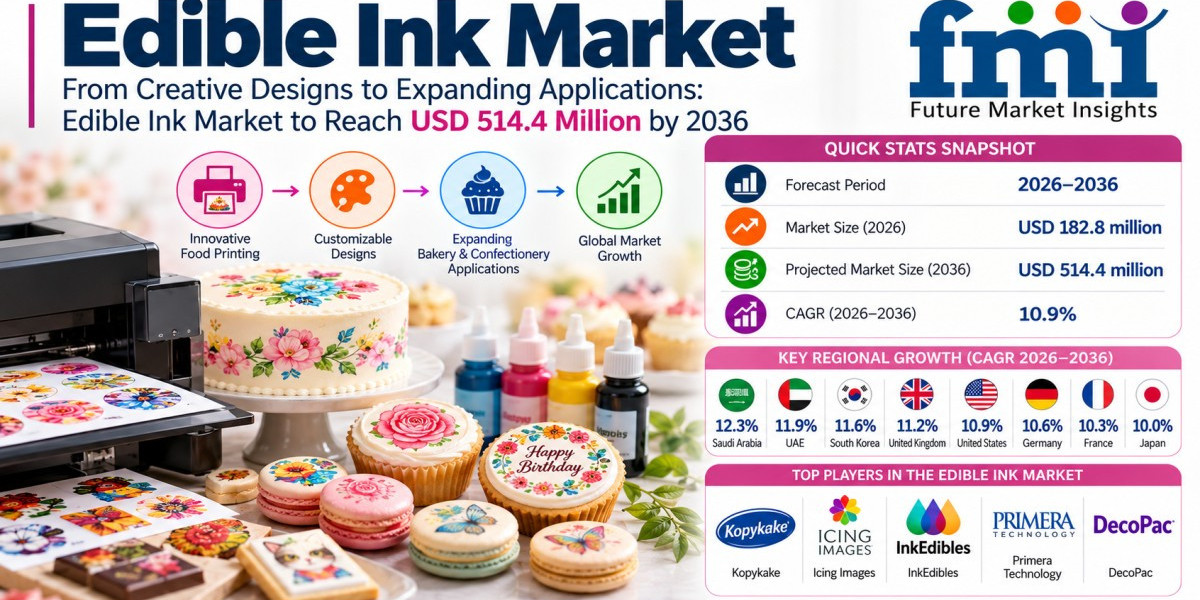

Future Market Insights projects the global edible ink market to grow at a 10.9% CAGR from 2026 to 2036, driven by demand for customized bakery decoration, food-safe printing solutions, natural color formulations, and personalized confectionery products.
Market Research Report: Edible Ink Market
Forecast Period: 2026–2036
Market Size (2026): USD 182.8 million
Projected Market Size (2036): USD 514.4 million
CAGR (2026–2036): 10.9%
Get detailed market forecasts, competitive benchmarking, and industry trends:
https://www.futuremarketinsights.com/reports/sample/rep-gb-35982
Global Edible Ink Market Forecast Signals Opportunities for Bakery Manufacturers
The global edible ink market is expanding as bakeries, confectionery manufacturers, and food businesses adopt printing technologies for customized designs, branded products, and personalized decorations. According to Future Market Insights (FMI), the market is estimated at USD 182.8 million in 2026 and is projected to reach USD 514.4 million by 2036, adding USD 331.6 million in market revenue.
Demand is supported by edible printing on bread, rolls, cakes, cookies, and specialty bakery products. Growing interest in natural food colors and changing regulatory requirements are also encouraging manufacturers to evaluate alternative ink formulations.
What Is Driving Growth in the Edible Ink Market?
Food customization and advancements in edible printing are creating opportunities for ink suppliers and bakery equipment manufacturers. Edible inks enable businesses to reproduce logos, photographs, decorative patterns, and personalized messages directly on food surfaces or edible sheets.
Regulatory developments are another important growth driver. The US Food and Drug Administration (FDA) has approved additional food colors from natural sources while pursuing the phase-out of specified petroleum-based synthetic dyes. These changes are encouraging manufacturers to assess replacement formulations.
However, maintaining color consistency, image resolution, food-surface compatibility, and regulatory compliance remains essential. Changes in color ingredients can affect the appearance of established designs, requiring testing under actual printing and production conditions.
Standard Grade and Bread & Rolls Create Segment Opportunities
FMI identifies standard-grade ink as the leading product type, accounting for 40.0% of market revenue in 2026, equivalent to approximately USD 73.1 million. Demand reflects the need for consistent printing performance across recurring bakery production runs.
By form, powder and dry products hold a 45.0% share, representing approximately USD 82.3 million in 2026. These formulations require suitable preparation, mixing consistency, and stability to achieve reliable printing results.
Bread and rolls represent the largest application segment, accounting for 34.0% of market revenue, or approximately USD 62.2 million in 2026. Meanwhile, direct sales to industrial bakeries account for 53.0% of sales channel revenue, highlighting the importance of supplier relationships and technical compatibility.
Regional Outlook: Saudi Arabia and the UAE Lead Growth Opportunities
FMI's country-level forecasts identify Saudi Arabia and the UAE as promising growth markets through 2036.
Saudi Arabia is projected to register a 12.3% CAGR, followed by the UAE at 11.9% and South Korea at 11.6%. The United Kingdom is forecast to grow at 11.2%, while the United States is projected to expand at 10.9%.
Germany is expected to record a 10.6% CAGR, followed by France at 10.3% and Japan at 10.0%.
These markets offer opportunities in customized bakery decoration, commercial cake printing, personalized confectionery, and food branding. Suppliers that combine compliant formulations with reliable printing performance may be better positioned to serve manufacturers adapting to changing customer and regulatory requirements.
Competitive Landscape: Top Players in the Edible Ink Market
Competition includes specialized edible ink manufacturers, food-printing system providers, and bakery decoration suppliers. FMI identifies the following five companies in its edible ink market analysis:
Kopykake — Edible inks and cake-imaging solutions.
Icing Images — Edible ink cartridges, refill bottles, and edible image printing supplies.
InkEdibles — Edible ink cartridges for compatible food-printing systems.
Primera Technology — Eddie edible ink cartridges for printing directly on cookies and other foods.
DecoPac — PhotoCake edible inks and cake-image production solutions.
These companies serve different printing workflows and product requirements. Their inclusion identifies relevant market participants rather than a verified ranking by edible-ink-specific revenue or market share.
Strategic Priorities for Businesses Entering the Edible Ink Market
Develop natural-color formulations: Evaluate alternative food colors that meet applicable regulatory requirements while maintaining the desired visual output.
Improve printing consistency: Test resolution, color reproduction, and image clarity on the actual food surface or edible sheet.
Strengthen regulatory compliance: Maintain ingredient specifications, identity and purity documentation, and appropriate food-use approvals.
Expand industrial partnerships: Work with bakeries to qualify inks for existing printers, production schedules, and recurring designs.
Optimize total operating costs: Consider ink consumption, cleaning requirements, preparation time, and rejected output when evaluating printing solutions.
Future Outlook for the Global Edible Ink Market
The edible ink market's projected expansion presents opportunities for specialty ink suppliers, bakery manufacturers, and food-decoration businesses. Long-term growth will depend on formulation innovation, regulatory readiness, reliable printing performance, and the ability to reproduce customized designs consistently.
Access the Full Edible Ink Market Report
For detailed market forecasts, segmentation, regional analysis, competitive insights, and strategic opportunities, access the report from Future Market Insights:
https://www.futuremarketinsights.com/reports/edible-ink-market
Explore More Research Reports by FMI
Edible Glitter Market -
https://www.futuremarketinsights.com/reports/edible-glitter-market
Food Color Market -
https://www.futuremarketinsights.com/reports/food-colors-market
About Future Market Insights (FMI)
Future Market Insights, Inc. (FMI) is an ESOMAR-certified, ISO 9001:2015 market research and consulting organization serving Fortune 500 clients and global enterprises. With operations in the United States, the United Kingdom, India, and Dubai, FMI provides data-backed insights and strategic intelligence across more than 30 industries and 1,200 markets worldwide.
For Press & Corporate Inquiries
Rahul Singh AVP – Marketing and Growth Strategy
Future Market Insights, Inc.
+91 8600020075
For Sales: sales@futuremarketinsights.com
For Media: Rahul.singh@futuremarketinsights.com
For Web: https://www.futuremarketinsights.com/