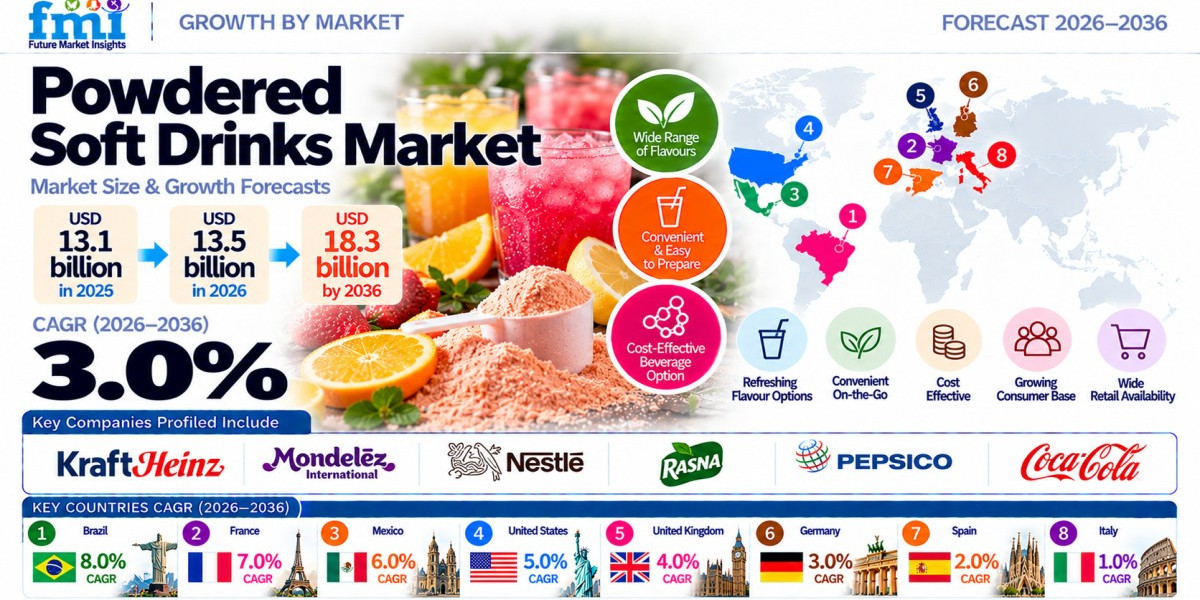

The global Powdered Soft Drinks Market is projected to grow from USD 13.1 billion in 2025 to USD 13.5 billion in 2026, reaching USD 18.3 billion by 2036, according to the latest market intelligence report published by Future Market Insights (FMI). The market is expected to expand at a compound annual growth rate (CAGR) of 3.0% from 2026 to 2036, supported by the cost advantages of dry beverage mixes, demand for familiar fruit flavors, and increasing interest in reduced-sugar and functional powder formulations.
Powdered soft drinks offer manufacturers and consumers an economical beverage format because water is added at the point of consumption. This reduces the need to transport finished beverage liquids while allowing households to prepare multiple servings from shelf-stable packs. Manufacturers are increasingly focusing on flavor innovation, convenient packaging, electrolyte-based formulations, and sugar reduction to maintain the category's value proposition amid competition from ready-to-drink beverages and evolving nutrition regulations.
Get detailed market forecasts, competitive benchmarking, and industry insights:
https://www.futuremarketinsights.com/reports/sample/rep-gb-8670
Market Size & Growth Forecasts
- 2025 Baseline Value: USD 13.1 billion
- 2026 Estimated Market Size: USD 13.5 billion
- 2036 Projected Market Value: USD 18.3 billion
- Growth Rate:0% CAGR (2026–2036)
- Incremental Growth Opportunity: USD 4.8 billion between 2026 and 2036
The market includes dry, shelf-stable powdered products used to prepare non-alcoholic soft drinks by adding water. Market segmentation covers flavour, end use, sales channel, packaging, and region. Demand is influenced by prepared-serving costs, household purchasing patterns, familiar flavor preferences, packaging efficiency, and the development of functional beverage applications.
Key Market Segments
By Flavour
- Orange: Expected to account for 30.0% of flavour demand in 2026, supported by broad consumer familiarity and compatibility with traditional fruit drinks and fortified formulations.
- Apple: Serves consumers seeking familiar fruit-based beverage options across household and other consumption settings.
- Lemon: Provides a recognizable citrus profile suitable for refreshing beverage preparations.
- Mixed Fruit: Offers blended fruit flavors that appeal to consumers seeking variety within established drink-mix categories.
- Mango: Supports demand for tropical fruit profiles and flavor diversification.
- Cola: Represents an alternative to traditional fruit-oriented powdered beverages.
- Berry: Adds fruit-based variety to product portfolios.
- Other Flavours: Includes additional formulations designed to address regional preferences and specialized consumer demand.
By End Use
- Household: Projected to account for 86.0% of end-use demand in 2026, supported by cost-effective multi-serving preparation, flexible dilution, and convenient pantry storage.
- HoReCa: Covers hotels, restaurants, cafés, and other hospitality establishments using powdered beverage mixes for beverage preparation and service.
- Institutional: Includes organizations requiring shelf-stable beverage formats for routine foodservice and other institutional applications.
By Sales Channel
- Mass Grocery Retailers: Expected to represent 38.0% of sales-channel demand in 2026, supported by routine grocery shopping, broad product assortments, and opportunities to compare pack prices and prepared-serving yields.
- Hypermarkets/Supermarkets: Provide access to multiple brands, flavor varieties, family packs, and single-serving formats.
- Discount Stores: Support price-conscious purchasing through value-oriented product assortments.
- Foodservice: Serves commercial establishments preparing beverages for customers and organized consumption settings.
- Wholesale Club Stores: Support bulk purchases and multi-pack distribution for households and commercial buyers.
- Other Channels: Include additional distribution routes serving powdered beverage demand.
By Packaging
- Pouches & Sachets: Forecast to account for 86.0% of packaging demand in 2026, supported by lightweight materials, portion control, compact storage, and cost-effective distribution.
- Carton Boxes: Provide an alternative format for selected powdered drink products and retail presentation requirements.
- Bulk Packaging: Serves larger-volume preparation needs across applicable commercial and institutional settings.
- Cans: Offer packaging options for selected powdered beverage formulations and storage requirements.
By Country and Region
FMI projects the following compound annual growth rates for key national markets from 2026 to 2036:
- Brazil: Expected to grow at an 8.0% CAGR, supported by household value purchasing and demand for affordable, multi-serving beverage formats.
- France: Forecast to expand at a 7.0% CAGR, with sugar-linked beverage taxation encouraging manufacturers to evaluate sweetness and formulation economics.
- Mexico: Projected to register a 6.0% CAGR, with taxation based on the prepared yield of qualifying powdered beverages influencing product formulation and pricing.
- United States: Expected to grow at a 5.0% CAGR, supported by established household drink-mix brands and expanding hydration-oriented powder products.
- United Kingdom: Forecast to expand at a 4.0% CAGR, with sugar-reduction requirements influencing product reformulation.
- Germany: Projected to register a 3.0% CAGR, with nutrition scrutiny and consumer taste expectations shaping product development.
- Spain: Expected to grow at a 2.0% CAGR, with regional taxation of certain soluble beverage preparations influencing pricing and product strategy.
- Italy: Forecast to expand at a 1.0% CAGR, with the timing of sugar-tax implementation influencing formulation and portfolio planning.
Major Market Trends and Growth Drivers
- Strong Value-per-Serving Proposition: Powdered soft drinks allow consumers to prepare multiple servings from compact, shelf-stable packages. By adding water at home or at the point of use, consumers can manage serving sizes and dilution while reducing the need to purchase fully prepared beverages.
- Continued Demand for Familiar Fruit Flavours: Orange leads the flavour segment because its familiar sweet-acid profile works across traditional drink mixes and selected fortified formulations. Established flavors help manufacturers introduce product variations without abandoning recognizable consumer preferences.
- Household Consumption and Pantry Convenience: Household users account for the largest end-use share because powdered beverages can be prepared as needed and stored in dry form before opening. Multi-serving packs and portioned sachets accommodate different household sizes and consumption occasions.
Competitive Landscape
The Powdered Soft Drinks Market includes established household drink-mix brands, fruit-beverage powder specialists, soluble beverage producers, and companies expanding into hydration-oriented formulations. Competition is shaped by flavor familiarity, prepared-serving economics, packaging efficiency, reduced-sugar options, functional ingredients, and retail distribution.
Key Companies Profiled Include: The Kraft Heinz Company; Mondelēz International; Nestlé S.A.; Rasna; PepsiCo, Inc.; and The Coca-Cola Company.
The Kraft Heinz Company serves the category through Kool-Aid and Crystal Light powder formats. Mondelēz International participates through Tang, while Rasna focuses on fruit-drink powders and value-oriented sachets. PepsiCo, Inc.
Recent Developments in the Powdered Soft Drinks Market
Recent product launches and portfolio initiatives highlight the category's focus on affordability, flavor experimentation, and functional formulation improvements.
- March 2025: Rasna launched Rasna Rich, a powdered fruit-drink product positioned around a richer sensory profile and an affordable sachet designed to prepare three glasses.
- April 2025: The Kraft Heinz Company used Kool-Aid's Mix n' Kicks initiative to introduce a limited-edition pack combining multiple flavors, encouraging household flavor experimentation.
- April 2026: PepsiCo announced that Gatorade's full powder-stick portfolio would remove artificial colors, reflecting continued attention to ingredient reformulation within functional hydration products.
Analyst Perspective / Insight
“Powdered soft drinks do not need to beat ready-to-drink beverages on convenience alone. Their stronger advantage is yield. Brands that can keep a clear cost-per-serving benefit while improving taste and adding useful functions have more room to grow without turning a traditionally value-led category into a premium niche.” — Nandini Roy Choudhury, Principal Consultant, Future Market Insights
For detailed market forecasts, flavour and packaging segmentation, country-level growth rates, and competitive analysis, read the Future Market Insights report:
https://www.futuremarketinsights.com/reports/powdered-soft-drinks-market
About Future Market Insights (FMI)
Future Market Insights, Inc. (FMI) is an ESOMAR-certified, ISO 9001:2015 market research and consulting organization, trusted by Fortune 500 clients and global enterprises. With operations in the U.S., UK, India, and Dubai, FMI provides data-backed insights and strategic intelligence across more than 30 industries and 1,200 markets worldwide.
For Press & Corporate Inquiries
Rahul Singh AVP – Marketing and Growth Strategy
Future Market Insights, Inc.
+91 8600020075
For Sales: sales@futuremarketinsights.com
For Media: Rahul.singh@futuremarketinsights.com
For Web: https://www.futuremarketinsights.com/