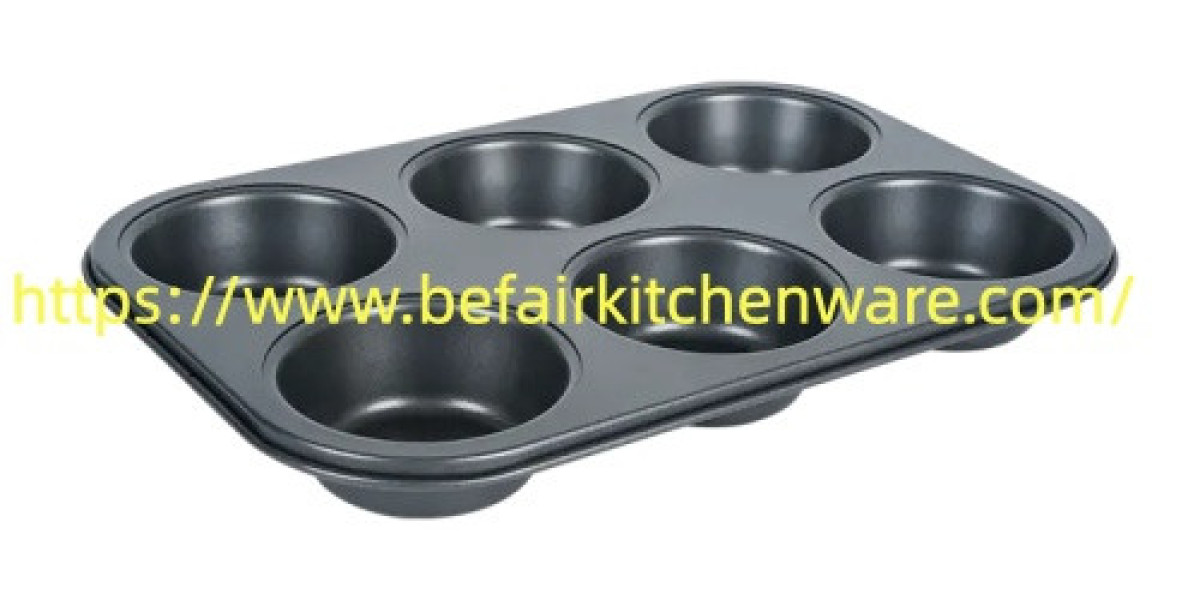

Muffin Pan material choice has a direct connection with heat movement, browning, release, handling, and cleaning during baking. Buyers comparing different designs should consider how the material responds to oven heat instead of focusing only on appearance or surface finish. Aluminum, steel, stainless steel, and silicone each have different thermal characteristics, and these differences can influence baking time and the appearance of finished products.
Aluminum is commonly selected for bakeware because it transfers heat efficiently. This can help batter heat relatively quickly and support even baking across the cavities when the construction and thickness are suitable. For recipes where consistent browning matters, thermal conductivity can be an important consideration. Aluminum is also relatively light, which can make larger trays easier to handle during loading, unloading, and storage.
Steel offers a different balance. Compared with lightweight aluminum, it can provide greater rigidity and structural support. This can be useful when trays are frequently moved, stacked, or used in busy baking environments. Aluminized steel combines a steel structure with an aluminum surface layer and is used in various bakeware designs where heat response and structural stability both matter.
Stainless steel is another option, particularly when buyers place value on corrosion resistance, appearance, and straightforward maintenance. Its thermal conductivity is lower than aluminum, so its heating behavior can differ. Some designs address this by combining materials or modifying construction to improve heat distribution. The appropriate choice depends on the intended recipe, oven, production conditions, and product specifications.
Material thickness should also be considered. A lightweight structure can reduce handling weight, while a thicker structure may provide greater rigidity and thermal stability. However, increasing thickness changes how quickly the product responds to temperature changes. Buyers should therefore evaluate thickness together with alloy, shape, cavity size, and oven conditions rather than treating it as an isolated specification.
Surface color and coating can also influence baking behavior. Dark surfaces generally absorb more heat than lighter surfaces, which may affect browning and baking time. A coating can also influence food release and cleaning requirements. Buyers should ask about the coating type, application process, recommended temperature range, and care instructions before selecting a finished product.
For food contact applications, the surface needs careful consideration. The FDA regulates substances that come into contact with food, including cookware and bakeware, and evaluates authorized food contact substances according to their intended uses. Buyers supplying different markets should therefore confirm applicable requirements and request relevant documentation from their manufacturing partner when needed.
The number and shape of cavities can change how heat reaches the batter. Closely spaced cavities create a different thermal environment from widely separated ones. The surrounding frame also affects rigidity and heat movement. Reinforced edges can support easier handling, while a suitable cavity wall thickness can help maintain consistent shape during repeated heating and cooling.
The oven itself should be included in the evaluation. Convection ovens, electric ovens, and other baking systems distribute heat differently. A product that performs well in one environment may require adjustments in another. Buyers should consider oven temperature, airflow, rack position, batch size, and baking time when evaluating material performance.
Recipe composition matters too. Batter containing higher levels of sugar, fat, fruit, or acidic ingredients may interact differently with various surfaces and coatings. Release characteristics can influence whether paper liners are needed or whether the finished products can be removed directly after cooling. Testing representative recipes can provide more useful information than relying only on material descriptions.
For wholesale buyers, manufacturing consistency is another important factor. Material thickness, cavity dimensions, coating coverage, edge forming, and overall shape should remain within agreed specifications throughout production. Inspection procedures can help identify variations before products are packed and shipped. This becomes especially useful when buyers are ordering large quantities for retail or food service markets.
Befair develops kitchenware with attention to material selection, forming methods, surface treatment, and practical handling requirements. Buyers can discuss cavity dimensions, material options, coatings, packaging, and other specifications according to their intended applications. This flexibility can be useful for distributors and importers who need products adapted to specific market requirements.
Before placing a production order, buyers should compare material, thickness, surface treatment, cavity size, oven compatibility, cleaning method, packaging, and testing requirements. A small sample run can also help confirm browning, release, handling, and cleaning performance before larger quantities are produced.
There is no single material that suits every baking environment. The right specification depends on the recipe, oven, production volume, handling method, and market expectations. A clear product brief allows manufacturers and buyers to work from the same requirements and reduces uncertainty during development.
Buyers looking for kitchenware manufacturing options can review Befair products and company information at https://www.befairkitchenware.com/product/