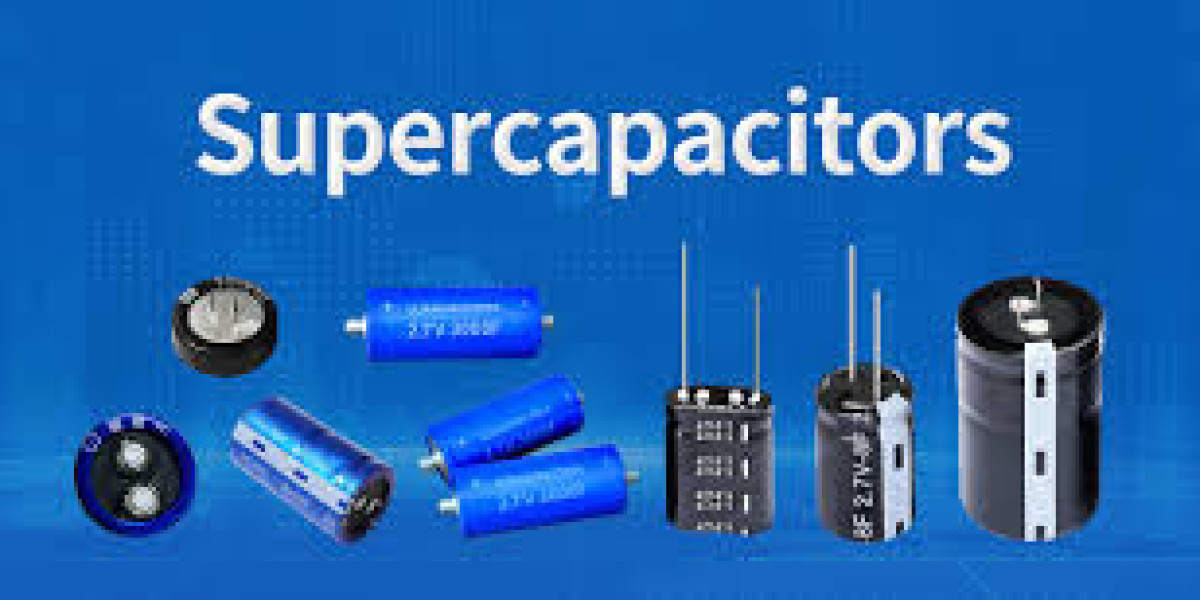

To fully grasp the breadth of this industry, one must look at the Super Capacitors Market segment data, which categorizes products based on their design and intended use. Double-layer capacitors (EDLCs) remain the most widely used type, relying on the physical adsorption of ions onto high-surface-area carbon. These are followed by pseudocapacitors, which utilize fast redox reactions to store energy, offering higher energy density at the cost of some cycle life. The third major segment is the hybrid capacitor, which combines the features of both EDLCs and batteries. Each of these segments serves a different purpose; for instance, EDLCs are perfect for small consumer electronics, while hybrid versions are increasingly found in heavy-duty industrial applications. This segmentation allows manufacturers to target specific performance metrics, such as voltage limits, capacitance, and thermal tolerance, ensuring that every application—from a toy car to a space station—has the right type of energy storage.
Beyond product types, the market is also segmented by end-user industries, including automotive, industrial, consumer electronics, and energy. The automotive segment is currently the largest, but the industrial sector is catching up fast as "Industry 4.0" takes hold. Automated guided vehicles (AGVs) in smart warehouses use super capacitors for rapid charging, allowing them to operate 24/7 without long breaks for battery recharging. In the consumer electronics segment, the demand is driven by the need for "burst" power in camera flashes and peak power management in high-end audio equipment. Even the energy sector is seeing a rise in the use of large-scale super capacitor modules for "frequency regulation," which involves keeping the grid's frequency stable. This granular view of the market reveals that super capacitors are not a one-size-fits-all solution but a diverse family of technologies that are being fine-tuned for a multitude of modern challenges.
What is the difference between an EDLC and a pseudocapacitor? EDLCs store energy through electrostatic charges on the surface of the electrode, while pseudocapacitors store energy through fast chemical redox reactions, providing higher energy density.
Why are hybrid capacitors gaining popularity? They offer a "middle ground" by providing better energy density than standard capacitors and better power density than batteries, making them versatile for many industrial uses.
➤➤➤Explore MRFR’s Related Ongoing Coverage In Semiconductor Industry:
Generative Ai In Fintech Market
Electric Vehicle Insurance Market
United Kingdom Asset Management Industry Market